PV Freund Logo
P V Freund
your energy pal
Homeowner reviewing independent solar calculation results on a laptop

Free PV Calculator — Calculate First, Talk to Installers Later

Use this free PV calculator to get precise yield, savings, and payback for your exact roof in 5 minutes. No sign-up — results stay with you.

Calculate My Savings — Free & Independent
✓ Free — No Hidden Costs ✓ No Sign-Up Required ✓ No Installer Calls ✓ Results in ~5 Minutes ✓ No Data Stored or Shared

A free calculator is only as good as the data and physics behind it. Here's exactly what goes into every PV Freund calculation — and why it lands within ±10% of your real meter reading.

  • 8,760h Simulated per year Every hour of the year modelled individually — not monthly averages.
  • 4 km Satellite grid resolution Weather data captured directly above your roof, not the nearest station.
  • 30 yrs Historical weather data Forecast based on three decades of local climate — not just last year.
  • ±10% Accuracy Honest, not optimistic — deliberately conservative so results hold up in the real world.

Three Doubts People Have About Free Solar Calculators

  • "Free online calculators give ballpark numbers, not real precision"

    PV Freund uses the same satellite weather data that professional energy consultants use — with 4 km grid resolution and an 8,760-hour annual simulation. Accurate to ±10%.

    The precision was always possible. The price is a choice.

  • "I'll get to the end and be asked to sign up to see my results"

    There is no gate. Your results appear directly in your browser — no email, no account, no final form. What you see is yours immediately.

    A gate means someone wants something from you. We don't.

  • "They say no data is stored — but how would I know?"

    Your inputs are sent to our server only to run the calculation — like a search query. Nothing is saved, logged, or shared afterwards. The only record of your results is the PDF you choose to download yourself.

    Storing data costs money. We have no reason to spend it.

Why a spreadsheet won't get you to ±10%

Manual calculations miss the factors that matter most. Here's what changes when you simulate instead of estimate.

Manual Calculation

  • Nearest weather station — can be 50 km away and miss your microclimate
  • Monthly irradiance averages — hide daily and seasonal variation
  • Generic tilt assumption (e.g. south 35°) — not your actual roof
  • Shading ignored or manually estimated
  • Load profile not matched — self-consumption is guessed
  • Hours of work to get a rough number
VS

PV Freund Simulation

  • Satellite data at 4 km resolution — directly above your roof
  • 8,760 hourly steps — every hour of the year simulated individually
  • Your exact roof geometry — pitch, orientation, and area per surface
  • Per-hour obstacle shading — draw trees and buildings on the map
  • Your actual consumption profile — matched hour by hour to solar production
  • Results in 5 minutes — no spreadsheet required

What you'll actually do — start to finish

Six steps. No surprises. Nothing you need to prepare in advance.

1

Find your address

Type your address and the map zooms to your roof. No account, no verification step.

3

Enter your consumption

Your annual electricity usage. Add EV or heat pump if you have them — or skip and use the default.

5

Choose your goal

Maximise savings, self-sufficiency, or payback speed — or set a custom system size and explore manually.

2

Draw your roof & obstacles

Outline your roof surfaces on the satellite map. Add any trees or buildings that cast shade — specify their height.

4

Set your costs

Grid tariff and feed-in rate. Sensible defaults are pre-filled — skip what you don't know.

6

Get your results

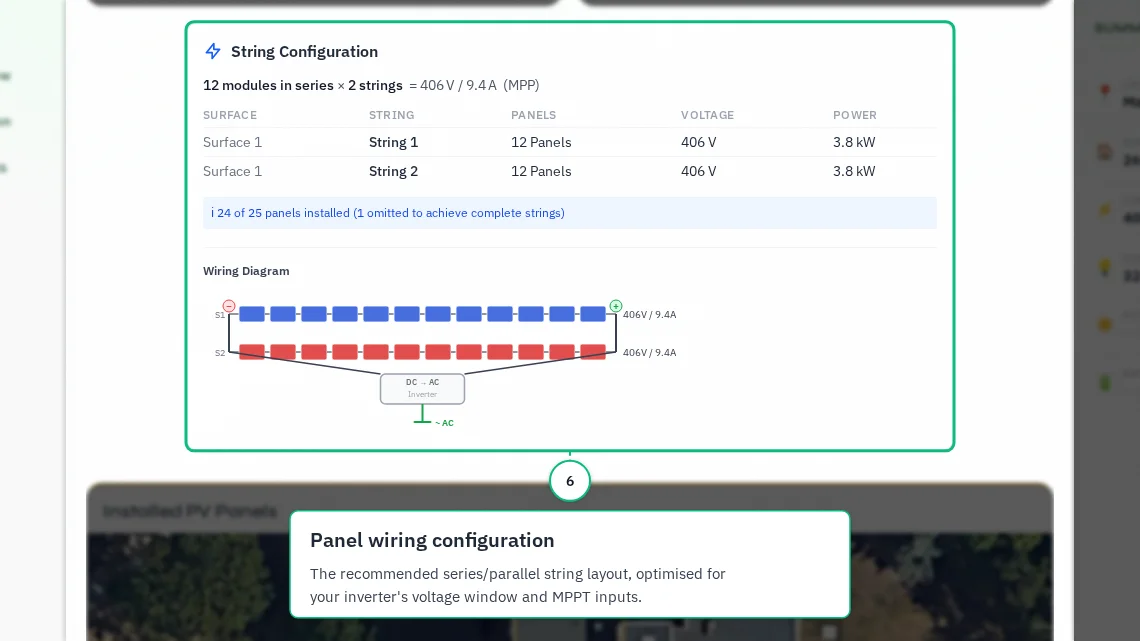
Yield, savings, payback period, and self-sufficiency — in your browser, immediately. No email required.

Your Numbers. Before Anyone Else Influences Them.

A real result from PV Freund — the same output you'll get for your own roof.
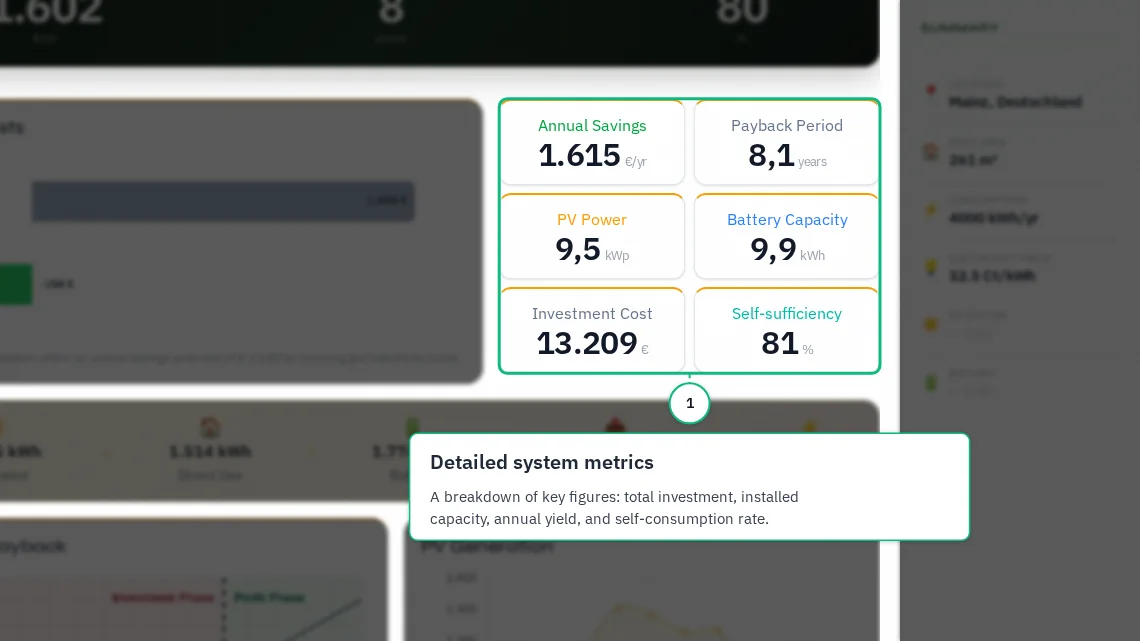
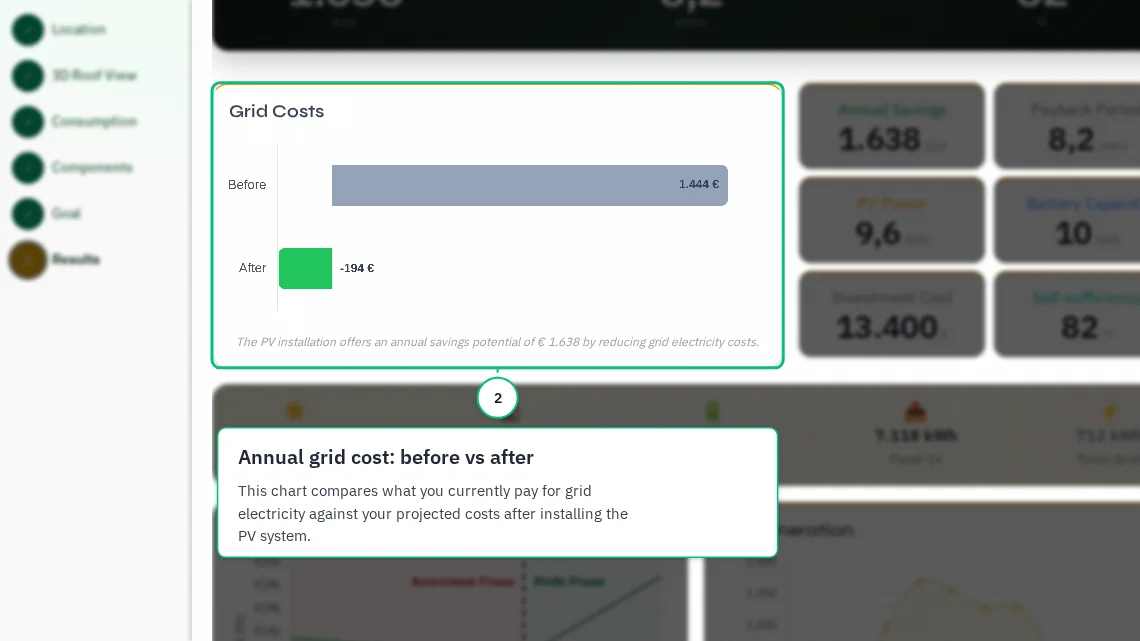
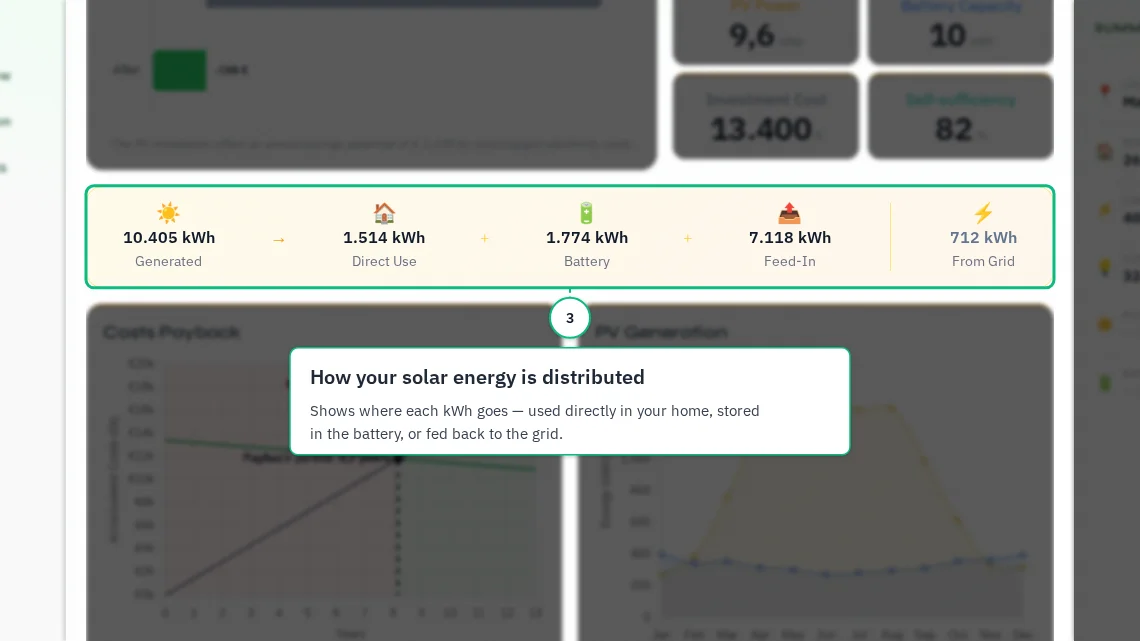
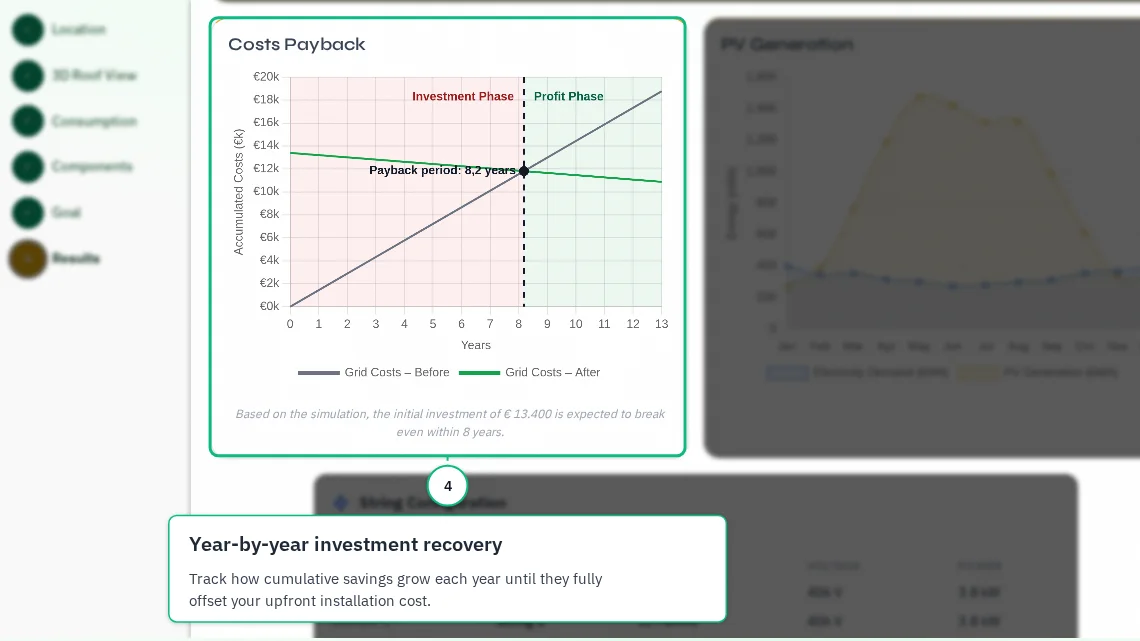
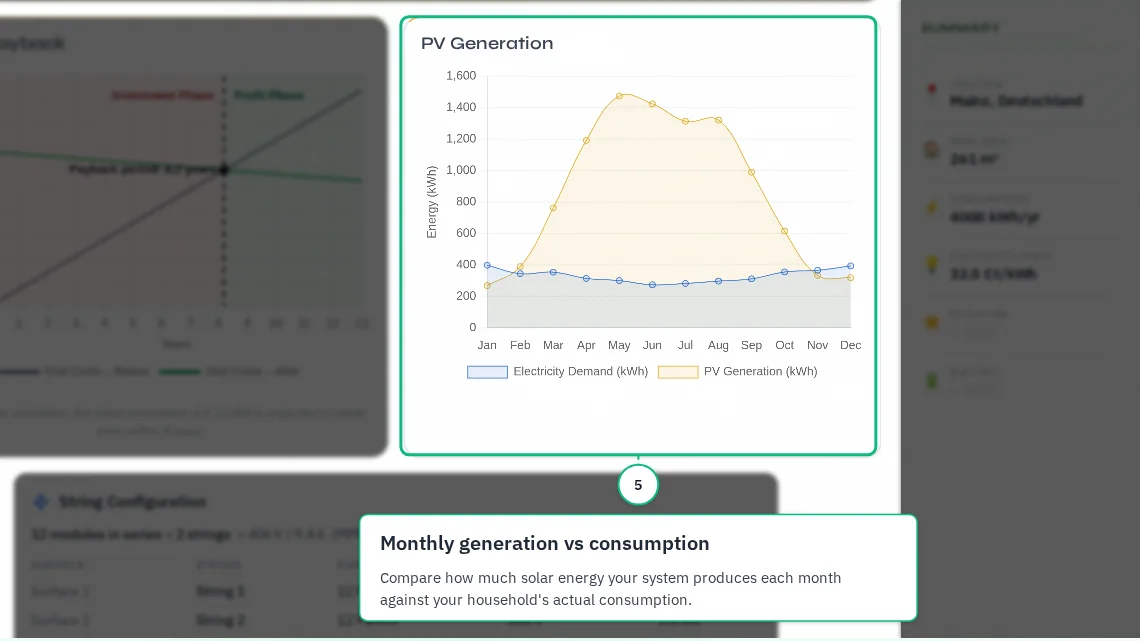
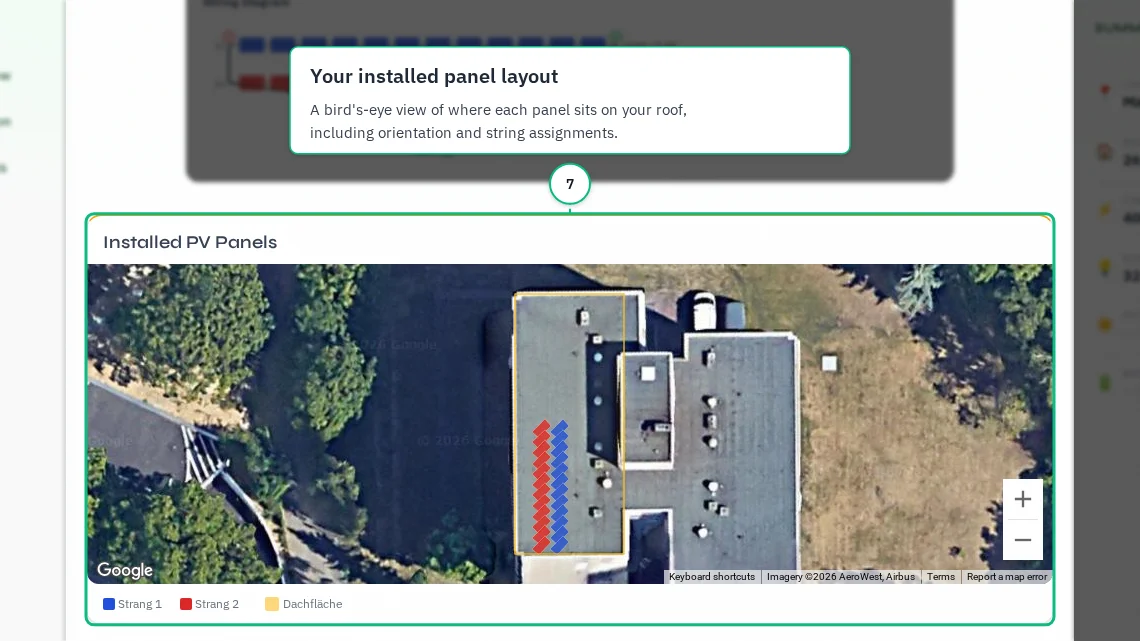
PV Freund solar calculator — detailed system metrics: total investment, installed capacity, annual yield and self-consumption rate PV Freund solar calculator — annual grid electricity cost before vs after solar installation PV Freund solar calculator — energy distribution showing direct home use, battery storage, and grid feed-in PV Freund solar calculator — year-by-year payback chart showing cumulative savings recovering installation cost PV Freund solar calculator — monthly solar generation vs household consumption comparison chart PV Freund solar calculator — recommended panel wiring string layout optimised for inverter voltage and MPPT inputs PV Freund solar calculator — bird's-eye panel map showing solar panel positions, orientation and string assignments on roof
1 2 3 4 5 6 7

How We Get to ±10% Accuracy

±10% accuracy doesn't happen by accident. Here's exactly what goes into every calculation.

Satellite weather data

We use satellite measurements taken directly above your roof, not the nearest weather station which could be 50 km away. 30 years of historical data at 4 km resolution. Your forecast reflects what the sky above your house actually does.

8,760-hour simulation

Every one of the 8,760 hours in a year is simulated individually — not monthly averages that hide seasonal variation. Your load profile is matched hour by hour to solar production, giving a realistic self-consumption rate rather than an optimistic guess.

Your exact roof geometry

Roof pitch, orientation, and azimuth are calculated per surface — not approximated with a generic "south-facing 35°" assumption. The angle sunlight hits your panels determines both yield and when that yield occurs during the day.

Temperature corrections

Panels lose efficiency when they overheat. On a hot summer day, panels run 40–50°C above air temperature. We factor in local temperature history for your area so summer output isn't overstated the way simple calculations often are.

3D Shading analysis

Ignoring obstacles leads to systematic overestimation. Draw any shading objects on the map and specify their height. PV Freund calculates for each of the 8,760 hours whether the sun is blocked — and reduces yield at module level accordingly.

What this calculator can't do

Knowing the limits of a tool is part of trusting it. Here's where PV Freund stops and real-world variability begins.

crazy-weather Created with Sketch.

Weather variance

Individual years can be up to +10% sunnier or −10% cloudier than the 30-year mean. Historical averages can't predict next year's sky — actual yield may swing 5–15% above or below forecast.

Soiling & pollution

Bird droppings, pollen, fine dust, and autumn leaves reduce efficiency by 2–5%. In agricultural or industrial areas this can be higher without regular professional module cleaning.

hourglass

Module degradation

High-quality monocrystalline modules lose ~0.5% of nominal power per year. Real-world savings will be slightly lower in later years than the 25-year forecast shows.

Dynamic shading

Growing trees and new neighbouring buildings can cast new shadows over a 20–30 year lifespan. A shading analysis is a snapshot — the profile should be rechecked periodically.

When Your Situation Is More Than Just Panels on a Roof

Most PV calculators stop at basic yield. PV Freund models the full picture — including the components most installers quote for separately.

  • Battery Storage

    Battery storage can raise self-sufficiency from ~30% to over 70% — if your tariff and usage timing support it. Model whether storage actually pays off for your specific consumption pattern, not just in theory.

    learn more →
  • EV Charging

    An EV roughly doubles your household consumption — the optimal system size changes significantly when you factor it in. Size your system around charging your car for free and see how it shifts your optimal PV configuration.

    learn more →
  • Heat Pump

    Heat pumps and solar are unusually well-matched — but only when the system is sized to your actual heating demand. Factor in heating demand for a complete energy picture. Sized correctly, they work exceptionally well together.

    learn more →

Frequently Asked Questions

What do I need to run a calculation?

Just your address, annual electricity consumption, and electricity tariff. Everything else has sensible defaults pre-filled — skip what you don't know.

What does ±10% accuracy actually mean?

In the best case your system produces 10% more than calculated, in the worst case 10% less. The main variables are weather variance year to year and shading changes over time. Our forecasts use 30 years of historical weather data and are deliberately conservative.

How does this differ from what an installer calculates?

An installer's quote is sized to sell you a system. PV Freund has no stake in the outcome — it optimises purely for your consumption, your roof, and your stated goal. Use your results to sense-check any quote you receive.

Can I compare PV-only against PV with battery?

Yes. In custom mode you can model any combination — system size, with or without storage, different storage capacities. Each variant immediately shows payback period, self-sufficiency, and 25-year savings.

Who can see my results?

Nobody. Your inputs are used only to run the calculation and discarded immediately after. No account, no history, no one else sees your numbers.

What if my roof has shading or multiple surfaces?

Both are supported. Draw shading obstacles directly on the map and specify their height. Multiple roof surfaces with different orientations can be combined — the calculator optimises each surface independently.

What can I do with my results afterwards?

Download the PDF and bring it to installer conversations. It gives you a verified independent baseline — system size, yield, payback, self-sufficiency — so you can compare quotes on equal terms.

Last updated: