Is a Home Battery Actually Worth It? Here's the Math.
No sales pitch. Just your roof, your consumption, and an honest payback calculation. Find out whether a battery improves your finances — or just adds cost.
✓ Free✓ No Registration✓ GDPR Compliant✓ EU-PVGIS Data
up to 80%Self-sufficiencyPV alone covers 30–40% of your needs. Add a correctly sized battery and that can rise to 70–80% — dramatically reducing your grid dependency.
10–15 yearsTypical paybackBattery prices have dropped over 80% since 2015. What used to take 20+ years to pay back now typically takes 10–15 — and improving every year.
5–15 kWhTypical home batteryMost residential batteries fall in this range. The right size for you depends on your consumption pattern and goals — not just system size.
€0Free & Non-bindingOur analysis is 100% free and does not oblige you to anything. Your data remains private and is not stored.
Figures based on PV Freund simulations using EU PVGIS weather data.
The Timing Problem: Why Solar Alone Isn't Enough
Your panels are working hardest while the house is empty.
Solar generation peaks between 11am and 2pm on a clear day. But most household electricity demand falls in the morning — when people shower, cook breakfast, and leave for work — and again in the evening when they return. The midday surplus that your panels produce has nowhere to go.
Without a battery, that surplus feeds back to the grid at the feed-in tariff — typically 7–9 cents per kWh in Germany. Then in the evening, you buy that same energy back from your provider at 28–35 cents per kWh. You're selling low and buying high, from your own roof.
A battery changes that equation. It stores the midday surplus and releases it in the evening, so you consume it yourself at full grid price value. The financial case isn't complicated — it's just arithmetic.
How Much Battery Do You Actually Need?
Three factors that most people get wrong — and that change the answer completely.
Your Daily Rhythm Matters More Than Your Annual kWh
Two households with identical annual consumption can need very different batteries. Someone who works from home runs their washing machine and dishwasher during solar peak hours — barely any surplus to store. Someone out of the house from 8am to 6pm generates all day and consumes almost none of it until evening. The gap between generation and consumption is what a battery fills — and that gap is determined by your daily pattern, not your annual total.
✓ Home during the day → smaller battery needed
✓ Out all day → bigger battery, bigger benefit
✓ Pattern modelled hour by hour
An EV or Heat Pump Shrinks the Battery You Need
This surprises most people. Adding an electric vehicle or heat pump to your home actually reduces the battery capacity you need. Both are large loads that can be scheduled to run during solar peak hours — directly absorbing the surplus before it reaches the battery. Less surplus left to store means a smaller battery gets you the same result. PV Freund models EV and heat pump schedules alongside your battery to find the genuinely optimal combination.
✓ EV charging scheduled to solar peak
✓ Heat pump pre-heats during solar hours
✓ More devices can mean less battery needed
Your Goal Changes the Optimal Size
There is no universally "right" battery size — only the right size for your goal. If your priority is maximum self-sufficiency, a larger battery (10–15 kWh) captures more evening and overnight demand. If your goal is the fastest financial return, the optimal battery is usually smaller — around 5–8 kWh for a typical home — because the last few kWh of storage capacity add cost faster than they add savings. PV Freund calculates both scenarios and shows you the exact numbers for your roof and consumption.
✓ Self-sufficiency goal → bigger battery
✓ Fastest ROI → sweet spot 5–8 kWh
✓ Exact size calculated for your situation
3 Things People Get Wrong About Home Batteries
Outdated numbers and misconceptions are keeping people from running the actual math.
"Batteries take 20 years to pay back. I'll wait."
That figure was accurate in 2015 when lithium battery costs were over €1,000/kWh. Prices have fallen more than 80% since then. A correctly sized system today typically pays back in 10–14 years — well within the battery's 15+ year lifespan.
Don't make a 2026 decision with 2015 data.
"My system is only 5 kWp. A battery won't make sense for me."
A household with a small system but high evening demand can benefit more from a battery than a household with twice the panels and nobody home all day. The economics depend on the gap between when you generate and when you consume — not on system size.
It's not about how much you produce. It's about when.
"If I add a battery, I'm basically going off-grid."
Over 95% of home batteries are grid-tied. You remain fully connected — the battery simply reduces how much grid electricity you buy. On cloudy days or during high-demand periods, you draw from the grid as normal.
A battery is an upgrade to your connection, not a replacement for it.
In 3 Steps to Your Personal Battery Payback
1
Map Your Roof & ConsumptionEnter your address and annual electricity consumption. PV Freund automatically pulls your roof geometry and local solar irradiance from EU PVGIS satellite data — no manual measurements needed.
2
Optimizer Finds Your Sweet SpotOur solver compares thousands of PV + battery size combinations across a full year of hourly data. It finds the combination that hits your specific goal — whether that's maximum self-sufficiency or the fastest financial return.
3
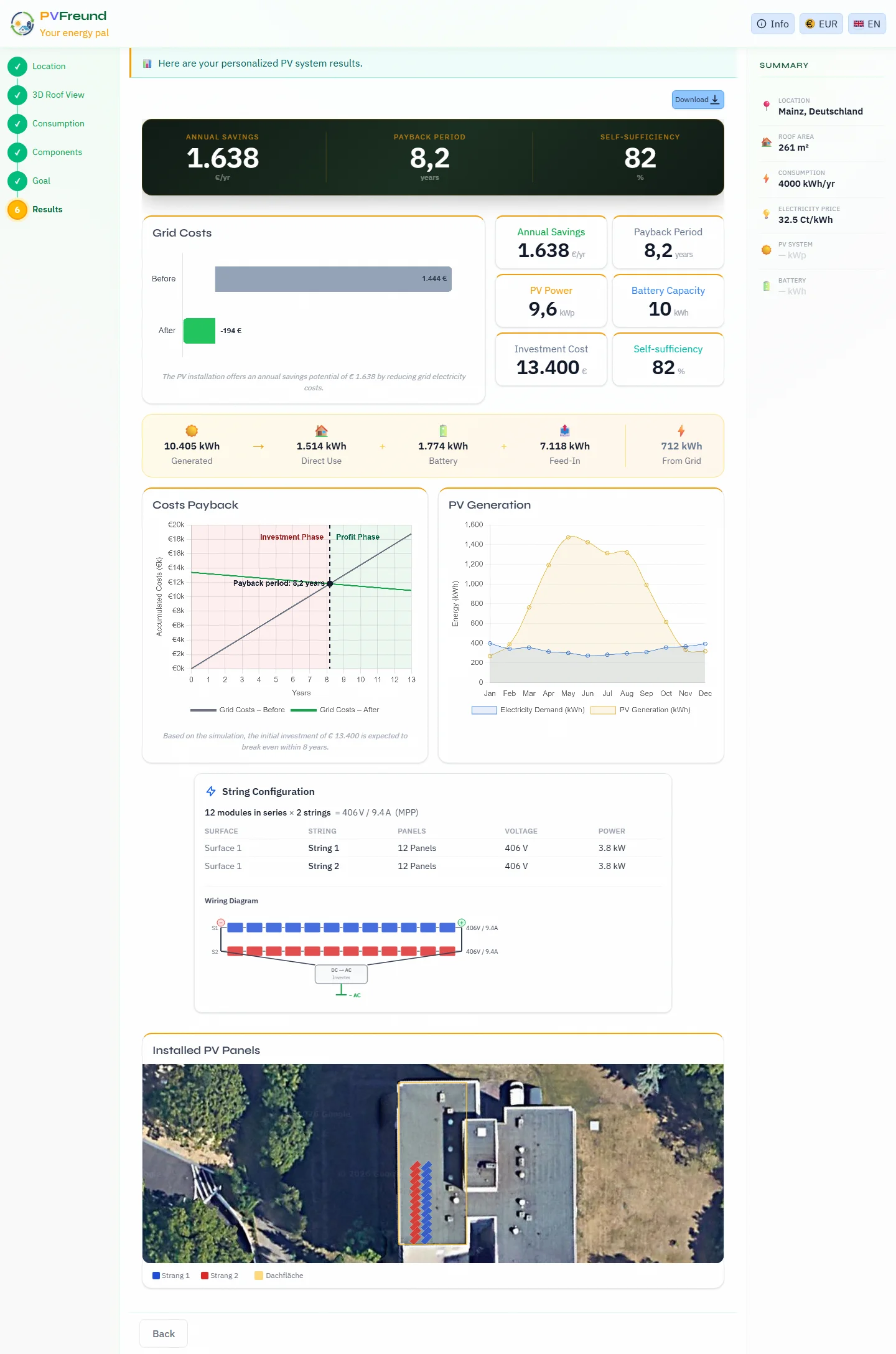
See Your Battery PaybackYou receive your self-sufficiency rate, annual savings, payback period, and the exact battery capacity recommended for your situation. If a battery doesn't improve your payback, we'll tell you that too.
Frequently Asked Questions about Home Battery Storage
Do I need solar panels to get a home battery?
Yes — a battery without solar panels is just a very expensive way to store grid electricity you're already paying for. The economics only work when you have your own solar production to store. The battery's job is to shift your own solar generation from midday to evening, not to stockpile cheap grid electricity.
What size battery do I need for a 5 kWp system?
For a typical household with a 5 kWp system, 5–8 kWh of storage is a good starting range. But the right size depends heavily on your consumption pattern — specifically how much electricity you use in the evenings and overnight. PV Freund calculates the exact capacity for your situation based on hourly simulation data.
How long does a home battery last?
Most lithium battery systems are warranted for 10 years and rated for 6,000+ charge cycles. In practice, many last 15+ years with gradual capacity fade — typically losing around 2–3% of capacity per year. PV Freund models this degradation in the payback calculation so your forecast is realistic, not optimistic.
Can a battery power my home during a blackout?
Only if it has a backup power (island mode) feature, which not all batteries include. Batteries with this feature automatically disconnect from the grid and power your home when an outage is detected. It adds some cost, but for households in areas with unreliable grid supply, it can be worth it. Check the spec sheet for your chosen system.
Does adding a battery always save money?
Not always. If you work from home and already consume most of your solar generation during the day, a battery adds significant cost without much financial benefit. PV Freund will tell you honestly when battery storage doesn't improve your payback — including the comparison between PV-only and PV+battery results side by side.
What happens to excess solar I can't store?
Any surplus beyond what your battery can hold is fed back to the grid. You receive a feed-in tariff for it — typically 7–9 cents per kWh in Germany, compared to 28–35 cents for grid electricity you buy. This is why storing it in your own battery first is almost always more valuable than exporting it.
GDPR CompliantYour data is not stored. All calculations take place in your browser.
EU-PVGIS DataWe use official, validated weather data from the European Commission for maximum accuracy.
No RegistrationNo account, no email. Just start and get results immediately.
100% FreePV Freund is and remains a free, independent tool for homeowners.