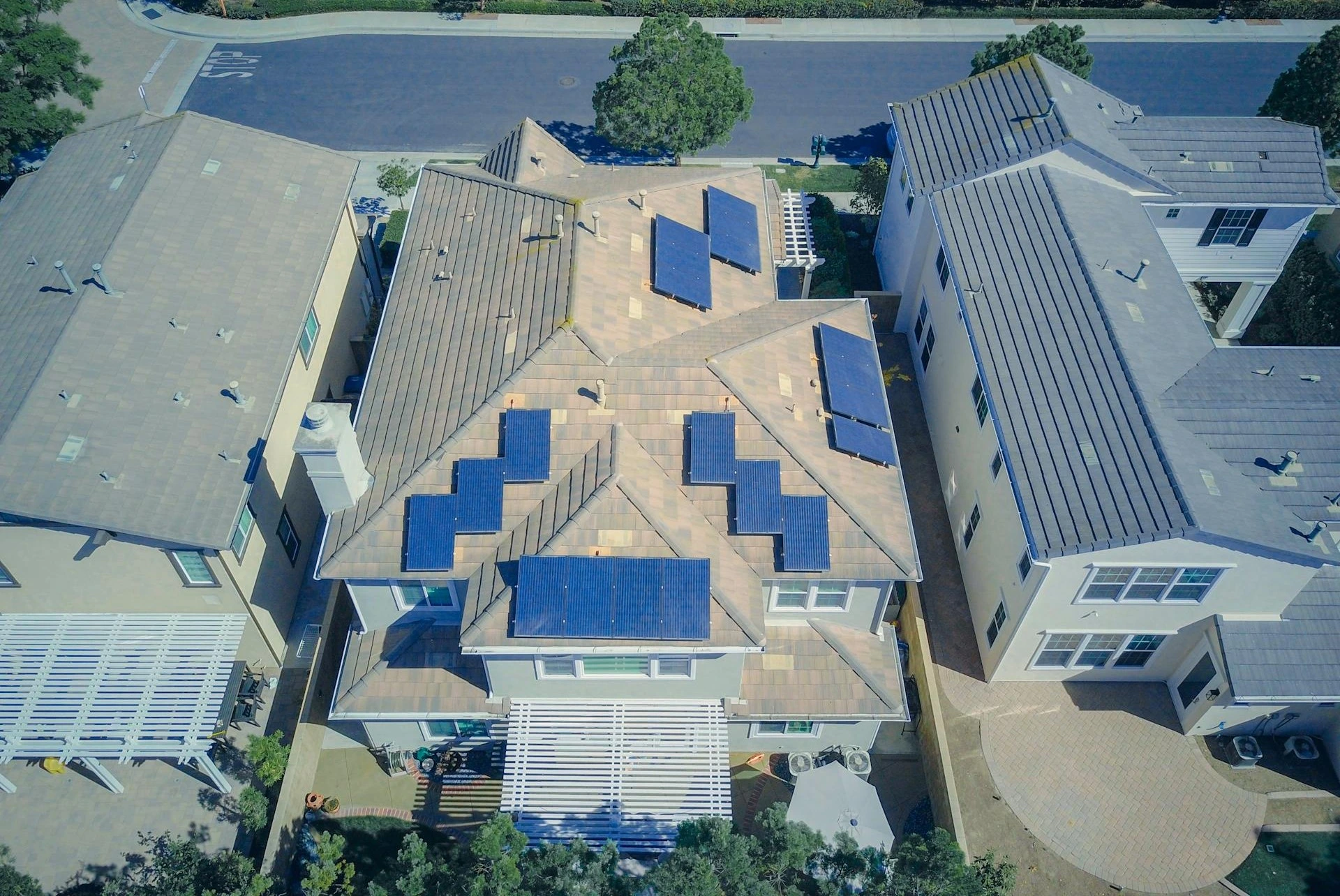
You've probably wondered. Now you can actually find out — what your roof generates, what you'd save each year, and whether solar makes financial sense for you.
Check My Roof →Which way your roof faces is just one piece of the puzzle. Your roof's angle, how sunny your area is, how much usable space you have, and when your household uses electricity — they all together tell you whether solar actually makes sense for you.
A south-facing roof is a good start. But it's rarely the deciding factor.
Partial shade affects some panels, not all of them. The rest of your roof still catches sunlight and generates electricity. How much it matters depends on your specific roof — where the shadow falls, how long it lasts, and how much unshaded area you have left.
Shade is part of the calculation — not the end of it.
Your address is used to find your roof on the map and account for neighbouring buildings that might cast shade. That's the only reason we need it — nothing more.
Storing data costs money. We have no reason to do it.
Here's exactly what you'll see — real numbers, your roof
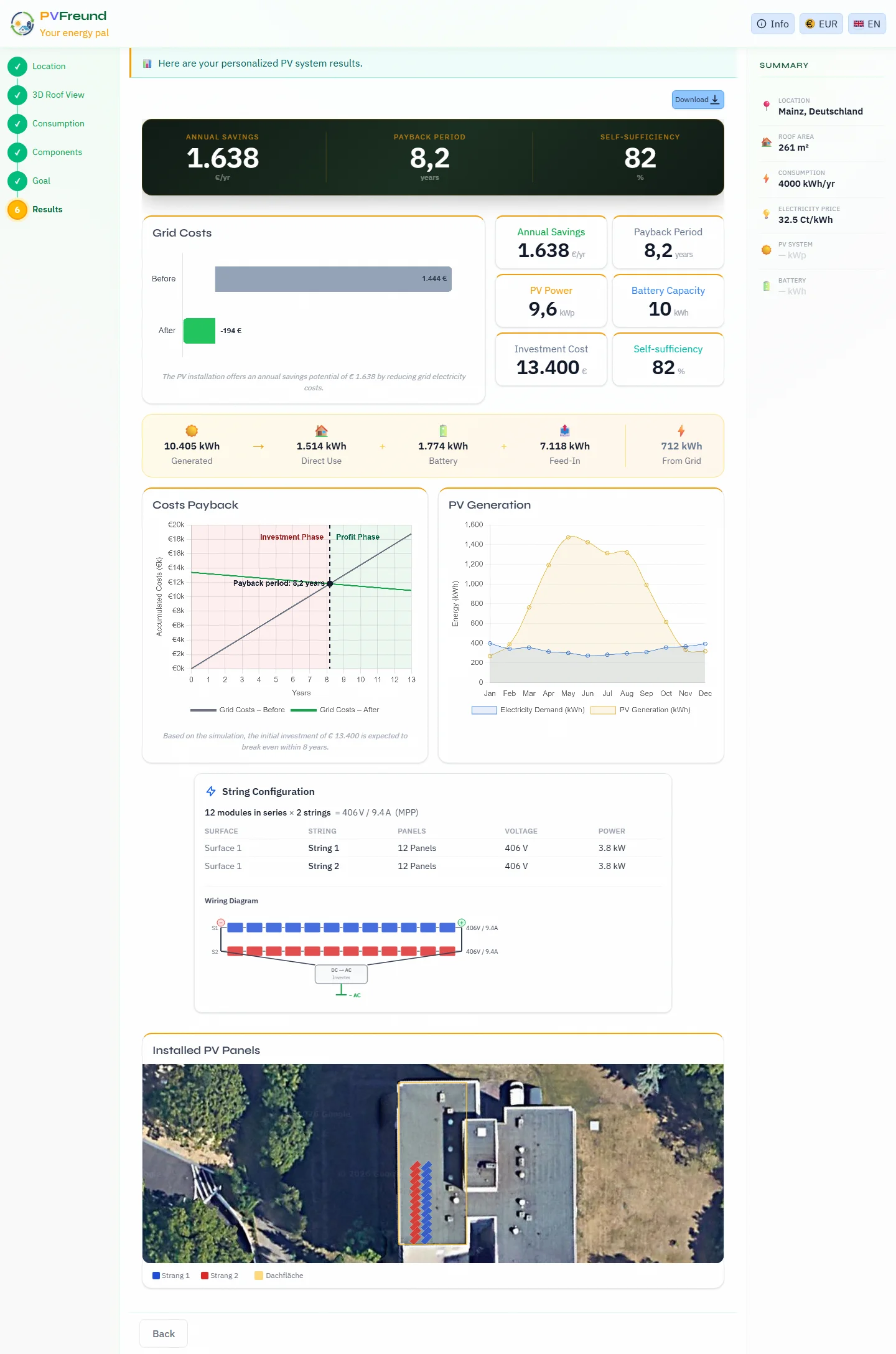
This is what we do with your address — a full solar simulation in 2 minutes.
Four variables shape what your roof can actually generate. No single factor tells the full story — the tool evaluates all four together.
South-facing roofs produce the most electricity over the year — output peaks around midday. East and west roofs generate less in total, but their output spreads across morning and evening, which is when most households actually consume electricity. That timing advantage often outweighs the yield difference, especially without battery storage. North-facing roofs are the genuine exception: they can still contribute, but only if the pitch is low and the other three factors are strong.
The optimal pitch depends on your latitude — lower latitudes benefit from a shallower angle, higher latitudes from steeper. For most pitched roofs, the structural slope already lands close to ideal without any adjustment. Deviating by 10 or even 20 degrees costs only a few percent of annual yield — not enough to matter financially. Flat roofs are the best case: panels are mounted on frames, so you choose the angle rather than inherit it.
The usable area is what remains after you subtract dormers, chimneys, skylights, and shaded zones. That number is usually smaller than the total roof — but smaller than most people expect is still enough. A clear 20 m² can cover a significant share of a typical household's electricity. Shape matters too: a compact rectangle fits more panels efficiently than a fragmented roof of the same total area. The tool lets you draw exactly what you have, so the figure you see reflects your actual roof, not a generic estimate. From there, our PV calculator turns your roof data into a complete financial projection.
A shadow that falls on part of your roof affects those panels, not the whole system. What matters is where it falls, how long it lasts, and how much unshaded area remains. A chimney shadow at 8am is a different problem from a neighbouring building blocking the south face all afternoon. PV Freund simulates shade across every hour of the year using 3D building models — so the yield figure you see already accounts for your specific obstructions, not a generic shading assumption. Curious how far you can take it? See what it takes to build a self-sufficient house.
Last updated: